

 January 2026
Corrosion Challenges in Automotive & Manufacturing Sector
1. Corrosion Loss in India – Corrosion costs the Indian economy over INR 2.2 lakh crore every year – equivalent to 3–4% of GDP. In the automotive and manufacturing sector alone, rust-related rejections, rework, and warranty claims exceed INR 18,000 crore annually estimated , making corrosion the single largest preventable loss in Indian industry today.
Corrosion is not always glaringly visible. However, just because you can't see it, does not mean that corrosion does not exist.
2. What is Micro/Flash-Rust?
New technologies are being developed to make automobiles lighter, perform better, faster and to make their production more cost-effective and sustainable. Modern high-speed machining with water-based coolants + complex alloys = flash /Micro rust in 4–12 hours. Hiding in blind holes, threads, and micro-crevices even when parts appear perfectly clean. Though not visible to the naked eye, this flash rust explodes into severe damage during storage or transit, causing massive rejections and warranty claims.
3. Use of Correct Process – MWF, Cleaner, and RPO to Eliminate Micro-Rust
Micro-rust can be eliminated only by using the right combination: a compatible metal working fluid (MWF), an effective interim cleaner that removes chloride and sulphate residues, and a fast water-displacing Low-VOC rust preventive oil (RPO). This scientifically matched triad ensures zero residual moisture and 100% protection from flash rust right from the machining stage.
4. Painted vehicle body is prone to Corrosion
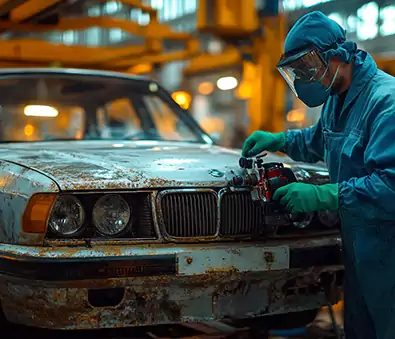
A Vehicle body, despite its well painted and coated exteriors, is subject to great corrosion stresses throughout, especially in areas containing body cavities, underbody, hinge and engine room areas which are subject to continual conditions of condensation, rain, mud, snow, salt and much more. Original coats of paint, however robust, fail to prevent these areas from corrosion by themselves and require additional coatings called waxes. These waxes play an important role in supporting the manufacturers' extending warranties for a corrosion-free life of vehicles.
Heavy-duty cavity waxes and underbody waxes form thick, self-healing, water-repelling barriers ideal for hinges, door cavities, rocker panels, and chassis components exposed to salt, moisture, and stone chips. These wax-based coatings provide 5–10 years of durable protection in the harshest Indian road and monsoon conditions now are widely used by all major Indian OEMs.
5. Importance of VCI Packaging during Storage and Shipment of Auto Components
VCI (Volatile Corrosion Inhibitor ) packaging is vital for safe storage and shipment of auto components. It releases protective vapor molecules that form an invisible anti-rust layer on steel, aluminum, copper, and other metals, blocking moisture, salt, and pollutants for 1–2 years. Unlike oily coatings, VCI keeps parts clean, dry, and ready-to-assemble, eliminating costly degreasing and preventing contamination on modern assembly lines. It withstands extreme humidity during long ocean freight and temperature swings, dramatically reducing scrap, rework, and warranty claims. Environmentally friendly and compliant with REACH/RoHS, VCI ensures global supply chain reliability while cutting logistics costs and ecological impact for the automotive industry.
6. Sustainable Corrosion Protection in India’s Automotive Industry
India’s emergence as the world’s third-largest automobile manufacturer and a major exporter of automotive components—with annual exports exceeding 20 billion USD—has amplified the need for robust and sustainable corrosion protection across the packaging value chain. Prolonged global transit, multi-modal logistics, and storage in high-humidity and saline environments expose precision metal parts, assemblies, and CKD/SKD kits to severe corrosion risk, while OEMs and Tier suppliers must simultaneously comply with increasingly stringent international environmental and packaging regulations.
Modern corrosion resistant packaging systems offer an integrated response to these challenges. Engineered dry-packaging configurations combine customized VCI films, papers, and emitters with desiccants, barrier laminates, and humidity indicators to create controlled micro-climates inside unit packs, returnable bins, and export containers. Zero- and low-VOC water-based and bio-based rust preventives ensure components remain clean, oil free, and assembly-ready at destination, reducing cleaning operations and line-side downtime.
Advanced biodegradable and recyclable VCI films and papers, many incorporating post-consumer recycled (PCR) align with OEM sustainability roadmaps and circular economy goals. These materials provide reliable multi-metal protection for up to 2–3 years, support downgauging and pack optimization to reduce material consumption, and are compatible with established waste-management and recycling streams. By integrating sustainable packaging design with corrosion engineering, automotive exporters in India can lower total cost of corrosion, enhance global supply-chain reliability, and meet evolving ESG and regulatory expectations.